Login
Login


The best custom drinkware depends on how people will use it, how long it needs to last, how much beverage it should hold, and how visible your printed design needs to be. Start by choosing the right drinkware format for the distribution setting, then match the material, capacity, and imprint style to your audience.
Custom drinkware includes reusable bottles, tumblers, mugs, cups, foam cups, stadium cups, specialty glasses, can coolers, and other beverage-related promotional items. The strongest choice is not always the largest or most premium-looking option; it is the one that fits the actual drinking occasion and keeps your brand visible during use.
Explore the full selection of Custom Drinkware before narrowing your choice by product type.
Quick Picks: Which Type of Custom Drinkware Fits Your Goal?
|
If your goal is… |
Start with… |
Why |
|
Everyday office or employee use |
Familiar format with repeat-use potential |
|
|
Portable commuting or travel |
Built for beverages away from a desk |
|
|
Sports, schools, and active events |
Portable and suited to active use |
|
|
Large-scale events and giveaways |
Practical for high-volume distribution |
|
|
Short-term beverage service |
Useful when cleanup and distribution speed matter |
|
|
Cold drinks with a translucent look |
Combines event use with a distinctive appearance |
|
|
Outdoor beverage service |
Lightweight and practical for group settings |
|
|
Beverage promotions and sampling |
Small-format option for controlled portions |
|
|
Beverage-related giveaways |
Supports canned beverage use and portable branding |
Shop Drinkware by Type
Everyday and reusable drinkware
Event cups and beverage service
- Custom Stadium Cups
- Custom Frosted Plastic Cups
- Custom Plastic Cups
- Custom Paper Cups
- Custom Foam Cups
- Custom Sample Cups
Specialty drinkware and accessories

Drinkware Sizes and Variants: What Should You Choose?
Capacity should follow the beverage occasion rather than the assumption that bigger is always better.
|
Option |
Best for |
Pros |
Watch-outs |
|
Small/sample format |
Tastings, demonstrations, controlled portions |
Compact, easy to distribute, efficient for sampling |
Limited space for larger artwork |
|
Standard cup format |
Events, offices, everyday beverages |
Familiar and versatile |
Capacity may not suit every beverage type |
|
Large cup format |
Long events and higher beverage volume |
Fewer refills |
Larger items require more storage space |
|
Mug format |
Coffee, tea, desk use |
Familiar and repeatable use |
Less portable than bottles or tumblers |
|
Tumbler format |
Travel and commuting |
Portable, often designed around mobile use |
Shape can affect usable imprint area |
|
Sports bottle format |
Fitness, schools, outdoor activities |
Easy to carry during active use |
Bottle shape and lid design vary by product |
|
Specialty glassware |
Hospitality, celebrations, beverage-specific settings |
Strong fit for themed experiences |
Material and handling requirements can differ |
A simple capacity rule
Choose capacity based on the expected beverage volume + refill availability + carrying convenience.
- For quick tastings, smaller formats reduce waste and simplify distribution.
- For long meetings or active environments, larger capacities can reduce refill frequency.
- For desk use, familiarity and comfort may matter more than maximum capacity.
- For portable use, consider whether the item will be carried in a bag, vehicle, or by hand.
How to Choose Custom Drinkware Step by Step
1. Define the drinking occasion
Ask where and when the item will be used.
- Desk or office
- Trade show or conference
- Outdoor event
- Sports activity
- Restaurant or hospitality setting
- Sampling station
- Employee or client gift
- School or campus event
The setting immediately changes the best combination of material, capacity, durability, and portability.
2. Decide whether the item is disposable, reusable, or long-term
This is one of the most important selection decisions.
Choose short-term service formats when:
- Fast distribution matters.
- Cleanup needs to stay simple.
- A large number of attendees will receive an item.
Choose reusable drinkware when:
- Repeat brand exposure matters.
- The item is intended for employees, customers, members, or long-term recipients.
- Portability or daily use is part of the goal.
3. Match the material to the environment
Different drinkware materials create different practical constraints.
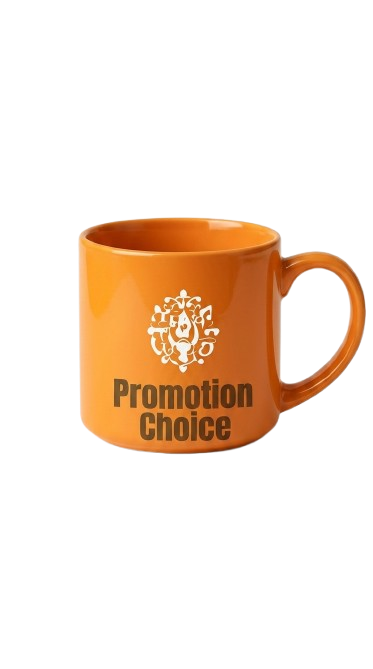
Ceramic is closely associated with desk and breakroom use.
Plastic can suit lightweight event distribution and reusable cup formats.
Paper is useful for beverage service where single-use convenience is important.
Foam may be considered for beverage service formats where insulation and handling characteristics matter.
Specialty materials and constructions may be better suited to tumblers, bottles, or beverage-specific products.
Always evaluate the actual product specifications before finalizing artwork or selecting a quantity.
4. Choose the capacity before choosing the artwork
Artwork should fit the available imprint area. A tall logo, detailed illustration, wide wordmark, or multi-element design may perform differently depending on whether the product has:
- A wide cylindrical print area
- A narrow vertical panel
- A curved surface
- A handle or lid that interrupts the available space
- A translucent or frosted finish
5. Choose the print style that matches the design
Simple artwork is generally easier to reproduce clearly across more drinkware shapes.
Use:
- Bold logos for smaller or curved imprint areas.
- Simple text when readability at a distance matters.
- Larger graphic elements when the product offers a broad decoration area.
- Detailed artwork only when the specific product and imprint method support that level of detail.
Avoid assuming every drinkware item can reproduce the same artwork equally well.
6. Plan quantity around distribution
Quantity should reflect the number of expected users, distribution method, and a reasonable operational buffer.
For example:
- A controlled employee distribution can often be planned close to the participant count plus extras for replacements.
- Open-access events may require a larger buffer because pickup rates are less predictable.
- Sampling programs should calculate quantity from expected interactions and servings per attendee rather than total attendance alone.
Drinkware Decision Table
|
Use case |
Recommended format |
Material direction |
Print approach |
|
Office coffee or tea |
Mug |
Ceramic |
Clear logo or readable wordmark |
|
Employee commuting |
Travel tumbler |
Product-specific reusable construction |
Simple branding positioned for visibility during use |
|
Sports or fitness |
Sports bottle |
Portable reusable material |
Bold logo with readable contrast |
|
Stadium or community event |
Stadium cup |
Plastic |
High-visibility event branding |
|
Beverage sampling |
Sample cup |
Product-specific service material |
Simple mark or event identifier |
|
Large outdoor event |
Plastic or frosted cup |
Lightweight event-friendly material |
Bold, high-contrast artwork |
|
Coffee service |
Paper or foam cup |
Service-oriented material |
Design optimized for the available print area |
|
Hospitality or themed beverage setting |
Specialty glass or beer stein |
Beverage-specific material |
Artwork matched to the product shape |
Branding and Print Tips for Custom Drinkware
Prioritize contrast
The design must remain readable against the actual product color and finish. A design that looks clear on a flat digital mockup may lose visibility on a dark, translucent, frosted, curved, or reflective surface.
Keep critical details away from edges
Curved surfaces can visually compress artwork near the sides of an imprint area. Keep small text and essential design elements comfortably inside the available print boundaries.
Design for viewing distance
Drinkware is often seen:
- In someone’s hand
- On a desk
- Across a table
- In a cup holder
- In a crowd
A large logo or short message is usually easier to recognize than a dense block of information.
Match artwork to the product shape
A wide horizontal logo may work naturally on one cup but require a different layout on a tall bottle or narrow tumbler. Do not force one composition onto every format.
Quantity Planning: Practical Starting Logic
Use the distribution model first.
Controlled distribution
Start with:
Expected recipients + replacement buffer
A practical planning buffer often depends on how critical it is to avoid running short, how many extras are needed for staff, and whether replacements will be available.
Open giveaway
Estimate:
Expected active participants × expected pickup rate + event buffer
Do not assume every attendee will take one item. At the same time, high-visibility giveaways can experience concentrated demand during peak periods.
Sampling
Estimate:
Expected samples per hour × service hours
Then add a buffer for higher-than-expected participation, operational waste, and staff use where relevant.
Common Drinkware Buying Mistakes
Choosing by appearance before use case
A visually attractive product can still be a poor fit if it is too large, too fragile, or impractical for the event.
Selecting capacity without considering beverage behavior
Match the size to how much people are actually expected to drink between refills.
Using artwork that is too detailed
Small text, thin lines, and dense graphics may lose clarity on limited or curved imprint areas.
Ignoring portability
For travel or active use, dimensions, lid construction, and carrying convenience can matter as much as capacity.
Treating all plastic or reusable drinkware as equivalent
Shape, thickness, finish, construction, and intended use can vary substantially between products.
Ordering without a distribution plan
Quantity requirements change depending on whether recipients are assigned an item, invited to pick one up, or served beverages throughout an event.
Forgetting companion products
Drinkware may work better as part of a larger event or employee kit. For example, outdoor programs may also benefit from related items such as Custom Towels or Custom Sunglasses when those products fit the campaign.

FAQs
What is the best type of custom drinkware for everyday use?
The best everyday drinkware is the format that matches the recipient’s normal beverage routine and environment. Ceramic mugs work naturally for desk use, while tumblers and sports bottles better suit portable use.
Should I choose a cup, tumbler, or bottle?
Choose a cup for event service and general beverage distribution, a tumbler for portable daily use, and a bottle when hydration and active use are the primary goals.
What drinkware works best for large events?
High-volume events usually benefit from lightweight, easy-to-distribute drinkware formats. Stadium cups, plastic cups, paper cups, and other event-oriented options can be evaluated based on beverage service and reuse goals.
Is reusable drinkware always the better choice?
No. Reusable products are useful when repeat use and longer brand exposure are important, while short-term service formats can be more appropriate for sampling or large-scale beverage distribution.
How should I choose a drinkware capacity?
Choose capacity according to expected beverage volume, refill availability, event duration, and portability requirements.
What artwork works best on drinkware?
Bold logos, clear type, strong contrast, and simplified graphics are generally easier to adapt across different product shapes and imprint areas.
Can the same design be used on every type of drinkware?
Not always. Different products have different printable areas, curves, handles, lids, finishes, and decoration methods. Artwork may need format-specific adjustments.
How many custom drinkware items should I order?
Start with your expected number of recipients or servings, then account for distribution uncertainty, staff needs, replacements, and a practical buffer.
Related Drinkware Choices
If you are narrowing your selection, start with these product paths:
- Custom Sports Bottles for active and portable hydration.
- Promotional Travel Tumblers for commuting and repeat daily use.
- Printed Ceramic Mugs for office and desk environments.
- Custom Stadium Cups for event-oriented distribution.
- Custom Frosted Plastic Cups for cold beverage events.
- Custom Paper Cups for beverage service.
- Specialty Cups & Glasses for beverage-specific and hospitality settings.
 October, 2026