Login
Login


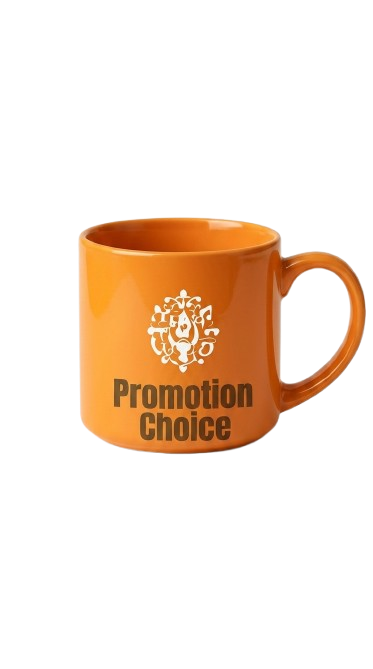
The most important rule for ceramic mug printing is: use simple, high-contrast artwork with clear spacing, because ceramic mugs perform best when designs are readable at a glance and not overloaded with detail.
Ceramic mugs offer one of the most forgiving print surfaces in promotional products, but that does not mean all artwork prints well. The combination of curvature, viewing angle, handle placement, and real-world use conditions means that clean, disciplined design always outperforms complex layouts.
If you are ready to apply these rules to actual products, browse Custom Ceramic Mugs. If you are still deciding between drinkware types, compare with Promotional Travel Tumblers.
What “good” ceramic mug artwork actually means

Good mug artwork is not about fitting as much information as possible. It is about:
- instant readability
- strong contrast
- clear focal point
- balanced spacing
- alignment with how the mug is held and viewed
A mug is not a flyer or a poster. It is a handled object. That changes everything.
Core rules for ceramic mug printing (apply these first)
1) Use one primary message, not multiple competing elements
- One logo or one clear message works best
- Avoid stacking multiple logos unless absolutely necessary
- Secondary text should support, not compete
2) Prioritize contrast over color variety
- Dark-on-light or light-on-dark prints read best
- Avoid low-contrast combinations (e.g., light gray on white)
- Complex gradients often lose clarity on curved surfaces
3) Keep text large enough for real-world viewing
- Mugs are viewed at arm’s length, not zoomed in
- Small text quickly becomes unreadable
- If text needs explanation, it is too dense
4) Respect the handle and grip zone
- Do not place critical elements where fingers wrap
- Keep key branding away from handle interference
- Design for how right- and left-handed users will see it
5) Use spacing (white space) intentionally
- Crowded designs feel cheap and reduce readability
- Leave breathing room around logos
- Let the mug surface act as part of the design
Print methods and how they affect your design
Different decoration methods change what artwork will succeed.
|
Print method |
Best for |
Detail limits |
Color advice |
Watch-outs |
|
Screen-style imprint |
simple logos, bold text |
limited fine detail |
use solid high-contrast colors |
avoid gradients and tiny text |
|
Full-color transfer/decal |
multi-color artwork, illustrations |
still needs clarity |
use strong contrast even in full color |
avoid overly dense compositions |
|
Wrap-around printing |
patterns or extended artwork |
alignment matters |
anchor design to a focal point |
avoid losing message across wrap |
|
Minimalist front print |
logo-centric branding |
very forgiving |
clean color choices |
strongest for office gifts |
Key takeaway
If your design is complex, test whether it still works when simplified. Simpler versions almost always perform better on mugs.
What prints cleanly vs what fails on mugs
Prints cleanly (high success rate)
- single-color logos
- bold icons or marks
- short phrases (1–5 words)
- high-contrast layouts
- centered designs
- minimal layouts with spacing
Often fails or underperforms
- paragraphs of text
- small disclaimers or fine print
- overly detailed illustrations
- low-contrast color schemes
- multiple competing logos
- crowded full-wrap designs with no focal point
Design placement: where should the logo go?
Standard front placement
Best for:
- office gifts
- client gifts
- brand-first visibility
Why it works:
- immediately visible
- clean presentation
- works for both right- and left-handed users
Side placement
Best for:
- subtle branding
- dual-sided designs
- mugs used in meetings
Watch-out:
- one side may face away depending on how it’s held
Wrap-around design
Best for:
- patterns
- storytelling designs
- themed campaigns
Watch-out:
- message can get lost across curvature
- alignment becomes more critical
Decision rule
If unsure → use front placement with a clean centered logo.
File preparation checklist (practical, not technical overload)
Before submitting artwork, confirm:
- artwork is high resolution (no pixelation)
- text is not too small
- colors are clearly defined
- spacing around the logo is consistent
- no unnecessary background clutter
- design works in both large and slightly reduced sizes
- key elements are not near edges or handle zones
Simple test
Zoom out or print the design on paper and hold it at arm’s length.
If you cannot read it instantly, simplify it.
Common mistakes and how to fix them
Mistake 1: Too much text
Problem: unreadable on curved surface
Fix: reduce to logo + short phrase
Mistake 2: Low contrast colors
Problem: design disappears under indoor lighting
Fix: switch to stronger contrast combinations
Mistake 3: Overly detailed artwork
Problem: fine details blur or clutter
Fix: simplify shapes and reduce elements
Mistake 4: Ignoring mug shape
Problem: design looks distorted or cramped
Fix: adjust layout to fit the mug’s profile
Mistake 5: Treating mug like a flyer
Problem: too much information
Fix: focus on one message, not many
Mistake 6: Placing key elements near handle
Problem: fingers block visibility
Fix: reposition design toward front-facing area
Mistake 7: Using inconsistent branding across sizes
Problem: design looks off on 11 oz vs 15 oz
Fix: scale and adjust layout per size
Related decision page: 11 oz vs 15 oz Custom Ceramic Mugs
How artwork changes based on use case
Office gifts
- clean logo
- minimal text
- high contrast
- front-facing placement
See: Best Custom Ceramic Mugs for Office Gifts
Fundraising or resale
- bold design
- clear message
- easy readability from a distance
Hospitality or café
- simple brand mark
- subtle placement
- repeatable aesthetic
Event gifting
- slightly more expressive design
- still keep readability priority
- avoid clutter
Artwork rules vs other drinkware types
Ceramic mugs are more forgiving than:
- Custom Paper Cups (smaller print zones)
- Custom Plastic Cups (different material behavior)
- Custom Foam Cups (limited detail capability)
Compared to Promotional Travel Tumblers:
- mugs handle simpler designs better
- tumblers require more attention to shape and curvature
Key takeaway
If your design is struggling to work on a tumbler, it will usually work better when simplified on a ceramic mug.
Internal linking hub (power station)
Shop ceramic mugs
Related drinkware
Related decision pages
- Custom Ceramic Mugs vs Travel Tumblers
- 11 oz vs 15 oz Custom Ceramic Mugs
Related use-case page
- Best Custom Ceramic Mugs for Office Gifts
Foundational guide
- Custom Ceramic Mugs Buyer’s Guide
FAQs
What is the best artwork style for ceramic mugs?
Simple, high-contrast logos with minimal text perform best because they remain readable during everyday use.
Can I print detailed artwork on ceramic mugs?
Yes, but simpler designs still perform better. Complex artwork often needs simplification to maintain clarity.
How big should my logo be on a mug?
Large enough to read at arm’s length without rotating the mug. Avoid overly small or overly dominant scaling.
Where should I place the logo on a mug?
Front-centered placement is the safest choice for visibility and usability.
Can I use multiple colors in my design?
Yes, but strong contrast matters more than the number of colors.
What should I avoid printing on mugs?
Avoid small text, dense paragraphs, low-contrast colors, and overly detailed graphics.
Do different mug sizes affect artwork?
Yes. Designs should be adjusted for different sizes to maintain balance and readability.
Is wrap-around printing better than front printing?
Not always. Wrap designs work for patterns, but front printing is often clearer for branding.
How do I know if my design will work?
If it is readable at a glance and looks clean when simplified, it will likely print well.
Are mugs easier to print than tumblers?
Generally yes, because mugs offer a more stable and predictable surface for simple designs.


 October, 2026